
So. You’ve returned to your Chinese Medicine practitioner because your headaches have returned. The practitioner tells you it’s due to Yin Deficiency, which was never fully addressed because you postponed therapy after only one session. He or she also reminds you of the reality: your condition requires patience—an extra measure of it—to endure a long-term therapy whose end cannot yet be predicted.
“Because if you don’t,” the practitioner says earnestly, “this is what you’ll go through again: you come to therapy, feel a little better, postpone—or even stop—therapy, and then the headaches return in some unexpected, deeply uncomfortable situation, much worse than before.”
You instinctively hold your head. It does hurt more than before. “How… you know… you’re right. I feel worse now,” you say slowly, your voice barely audible.
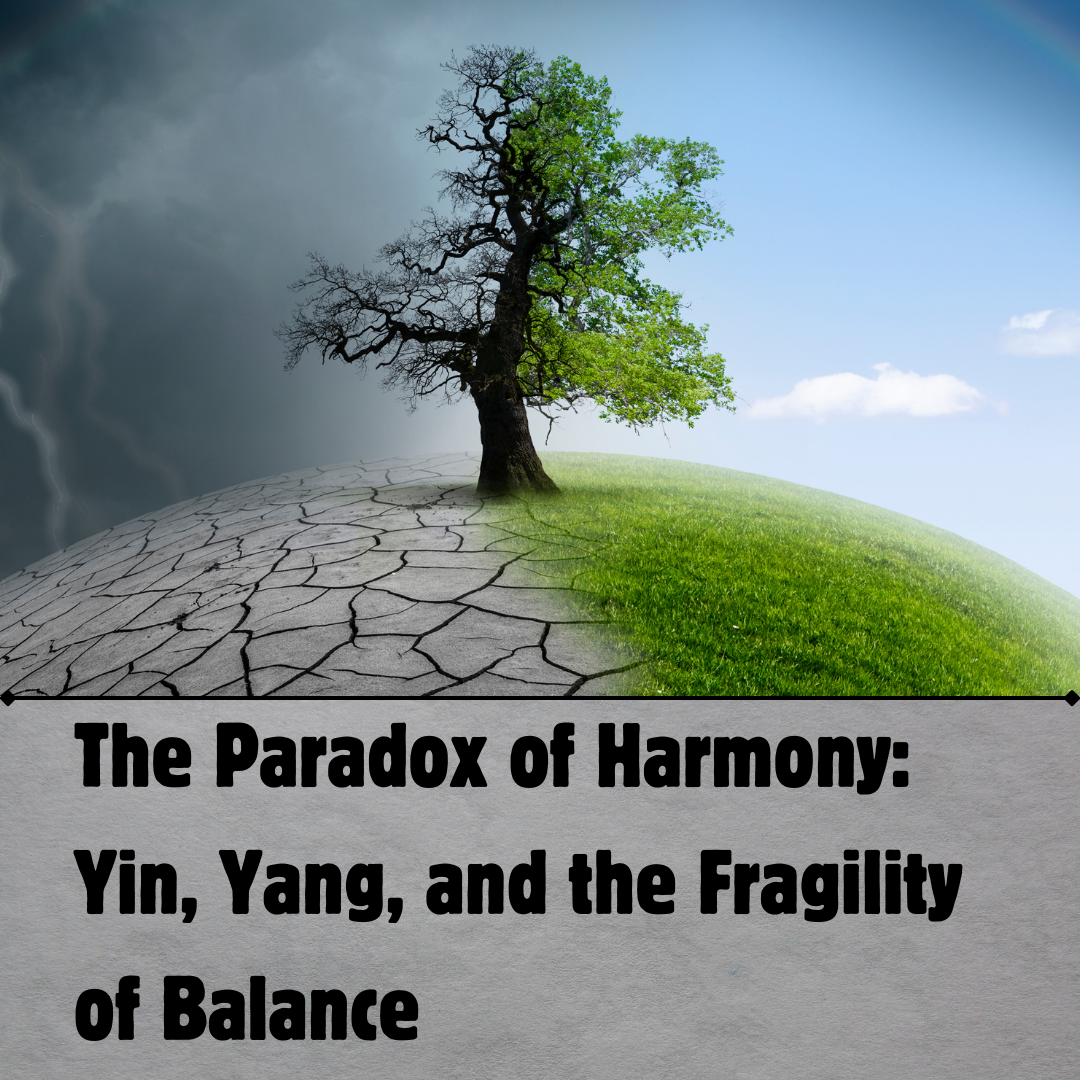
“Because the root of the disease hasn’t been resolved; instead, it has been compounded by additional problems. You felt better, but only superficially. The root was never touched as much as we had hoped. But you can’t possibly avoid work, can you? You can’t possibly escape work-related problems in the office, can you? No matter how small the stress you face, it is still a ‘stressor.’ Fortunately, for most people—especially those whose constitutions are balanced in Yin and Yang—such stressors are insignificant. Those with balanced Yin and Yang can adapt to life’s storms, however fierce. Of course, even they can falter, their Yin and Yang thrown into chaos, leading to illness. But for you, with Yin and Yang utterly out of balance, the situation is different. Your very weak Yin may rise slightly, only to be struck again by another stressor. This, in turn, further reduces your Yin, allowing Yang to surge and become even more hyperactive than before, worsening your condition.”
You listen intently to the practitioner’s explanation, then nod. “That’s right. My headaches never used to reach my eyes. Now, besides the headache, my eyes are so painful and tight they feel as if they’re about to pop out.”
“Is the pain only on one side of your head, or on both?”
“Only on one side—the left. These days, whenever I get a headache, it’s always there, never anywhere else.” You lean forward slightly, curiosity sharpening your voice. “Is this a migraine?”
“Your symptoms—as you describe them: recurrent headaches, one-sided location, and moderate to severe pain that disrupts daily activities—are often seen in cases of what Western medicine calls ‘migraine.’ In Traditional Chinese Medicine, however, your case is related to Hyperactive Yang due to Yin Deficiency. My role is to restore your body’s balance according to TCM principles.”
You nod again. “Chinese Medicine is fascinating, isn’t it? It doesn’t diagnose in the usual terms—migraine, hypertension, cholesterol, diabetes. Instead, the names are intriguing: Yin Deficiency, Hyperactive Yang. Very interesting.” Your eyes glimmer with curiosity. “And you also checked my tongue and pulse. That was unlike any conventional treatment I’ve ever experienced. It felt… unreal… almost like fantasy…”
“It’s like watching an ancient Chinese epic,” the practitioner smiles. “You’re not alone—most of my patients feel the same.”
You smile faintly. “I’ve never watched an ancient Chinese drama.”
“The scenes depicting Chinese medical practice are almost identical to what we do today—only set in the past. Traditional clothing, traditional buildings—and, of course, spoken in Mandarin. Although there are also dramas with modern settings. In those cases, what you see is almost exactly what we do now.”
“The only difference is—the practice is conducted in Mandarin,” you remark. The practitioner smiles broadly.
You return to a serious tone. “Can you explain what you observed from your examination?”
Symptoms, Signs, and Syndromes
Chinese Medicine practitioners work with three crucial diagnostic elements: Symptoms, Signs, and Syndromes.
A symptom (症, Zhèng) is a complaint reported by the patient—something unknown to the practitioner until the patient describes it.
Signs (征, Zhēng) are observable features detected by the practitioner through inspection, listening, smelling, and palpation.
A syndrome (证, Zhèng) is a pattern of disharmony identified through TCM diagnostic methods—such as tongue inspection, pulse reading, and the correlation of symptoms and signs. A syndrome reflects the root cause of the disease, not just its surface manifestation. It serves as the comprehensive diagnostic conclusion (e.g., Yin Deficiency) from which therapy is determined (e.g., “Tonify Yin”). In your case, the syndrome is Yin Deficiency leading to Yang Hyperactivity.
For you, the symptoms and signs pointing to this syndrome are:
Symptoms: headache extending to the eyes (with eye strain and the sensation they might pop out), restlessness, irritability, pain in the neck and shoulders, and chest tightness due to difficulty breathing.
Signs:
- Observation: Your face is slightly flushed, your expression tense, overly serious, with visible discomfort. Your tongue has little coating and several cracks.
- Hearing and Smell: No notable findings in your case.
- Touch: Palpation of the neck, shoulders, and related areas reveals stiffness and tension. Pulse diagnosis shows a wiry, forceful, and rapid pulse.
Naturally, your curiosity is piqued by the tongue and pulse findings. What does a cracked, uncoated tongue mean? What is a wiry, forceful pulse?
I understand your curiosity—it’s an excellent sign—but explaining tongue and pulse diagnosis would take time. For now, let’s return to the conclusion: both clearly indicate Yin Deficiency.
Here’s why:
- Headache with distending pain, radiating to the eyes: This distension occurs when Yang rises unchecked because Yin is too weak to anchor it. Yin should restrain Yang, but when Yin is deficient, Yang surges upward, affecting the head, neck, and shoulders.
- Headache affecting the eyes: In TCM, the eyes are associated with the Liver. The Liver is often implicated in Hyperactive Yang due to Yin Deficiency.
- Restlessness and irritability: Yin provides calm and allows rest. Without sufficient Yin, tranquility disappears, replaced by agitation. In the Five Elements theory, anger—your resulting emotional state—is also linked to the Liver.
- Chest tightness and difficulty breathing: The Liver governs the smooth flow of Qi. The chest is the central hub for Qi regulation. When Liver function is impaired, Qi stagnates, leading to chest tightness and labored breathing.
At this point, your mind races with questions: Qi? Energy? The Five Elements? The Five Emotions? Why are the Liver and eyes connected? Why does the Liver regulate energy flow? Why is anger linked to the Liver instead of the brain?
I understand your confusion. Before studying Chinese Medicine, I felt exactly the same. As modern people steeped in scientific thinking, we find TCM turns our understanding upside down.
But isn’t that precisely what makes it so compelling?
When knowledge you once thought absolute is challenged by something unfamiliar, strange, and yet deeply intriguing?
So now I ask you:
Are you ready to go further—and dig deeper?
References:
1. Maciocia, G. (2015). The Foundations of Chinese Medicine: A Comprehensive Text for Acupuncturists and Herbalists (3rd ed.). Elsevier.
2. Zhu, B., & Wang, H. (2010). Chinese Medicine Diagnosis Study Guide. People’s Medical Publishing House.
3. World Health Organization (WHO). (2007). WHO International Standard Terminologies on Traditional Medicine in the Western Pacific Region.
Link: https://iris.who.int/handle/10665/206952
4. Standardization Administration of China. (1997). Basic Terminology of Traditional Chinese Medicine (GB/T 16751.1-1997).
Disclaimer:
This content offers high-level insights intended to stimulate intellectual discussion. It draws from research and analysis, integrating perspectives from Chinese Medicine and related disciplines. However, it is not a substitute for professional medical, scientific, or clinical advice. Readers are encouraged to engage critically and consult a qualified Chinese medicine practitioner or licensed healthcare professional when appropriate.